Most weeks, someone gets in touch who's been let down by a bike that didn't fit them. Usually it's a taller or heavier rider – knees catching the bars on a frame built for someone smaller, or a motor that runs out of puff on the hill home with a bag of gear on their back. It's one of the most common reasons people end up with an e-bike they quietly stop riding within a couple of months.
Here's the thing – it's rarely the rider's fault. It's a fit and payload problem, and it's easily avoided once you know what to look for. So this guide to the best electric bikes for men isn't really about "men's bikes" as a category – it's about the e-bikes I'd actually point a larger, taller, or load-carrying rider towards, and why. Every one is a bike we stock and sell, chosen on fit and capability rather than the colour of the paint.
Who This Guide Is For
This is for riders who've found that "one size fits all" tends to mean "fits someone smaller than me." Maybe you're over six foot and tired of cramped cockpits. Maybe you're a heavier rider who wants a frame and payload rating you can trust. Maybe your patch is hilly – Sheffield, the South Pennines, the climbs out of Bath – and you've learned that motor torque matters more than top speed. Or maybe you just want to haul tools, shopping, or a dog up front without the back end squatting.
If you're a smaller or lighter rider, or you're mainly after something compact for the train, don't worry – none of this rules you out, but our best folding electric bikes guide is probably a better starting point. Everyone else, read on. I'll explain what actually matters first, then walk through five bikes I'd genuinely recommend.
What Actually Matters When You're Buying for Size and Power
Truth be told, most "best electric bike for men" lists skip the only things that matter to a bigger rider and just rank bikes by battery size. Let me break down what I'd actually check, in order.
Frame fit comes first, and it's not just height. Every bike has a recommended rider-height range, and it's worth taking seriously. A frame rated to 6'2" will technically carry a 6'5" rider, but the reach and standover will feel cramped, and you'll end up with the saddle jacked up high and your weight too far back. Taller riders should look for either a genuinely big frame or a model that offers a high-step (crossbar) option, which usually means a longer reach and more room in the cockpit than the step-through version of the same bike. Those knees-on-the-bars problems are almost always a fit problem, not a rider problem.
Payload capacity is the spec nobody mentions. This is the maximum the bike is rated to carry – you, your clothes, your bag, everything. Plenty of e-bikes are rated to 120 kg (about nineteen stone all-in), which sounds generous until you add a seventeen-stone rider, a rucksack of tools, and a winter coat. Go over it and you're not just risking the warranty – you'll feel it in a frame that flexes and brakes that fade. For heavier riders, or anyone carrying loads, I'd treat 150 kg as the sensible floor, and there's one bike here that goes to 200 kg.
Power delivery matters more than the number on the motor. Every road-legal e-bike in the UK is capped at 250W and stops assisting at 15.5 mph – that's the EAPC (Electrically Assisted Pedal Cycle) rule, and it's what lets you ride with no licence, tax, or insurance. So you can't buy "more watts" legally. What you can buy is better torque and a better sensor. A torque sensor reads how hard you're actually pushing and feeds power in proportionally, which is night and day for a heavier rider on a hill compared with a basic cadence sensor that just dumps a fixed amount of assistance the moment the pedals turn. Torque figures like 75 Nm or 90 Nm tell you how much shove the motor can give when you're grinding uphill into a headwind. That's the number that matters on the climb back up to Crookes.
Tyres and suspension decide how rough roads feel. Wide fat tyres – usually 4 inches across – act like a second suspension system, taking the sting out of potholes, dropped kerbs, and canal towpaths before it reaches your back. They do add weight and a touch of rolling resistance, but on an electric bike the motor shrugs that off. If your roads are genuinely broken up, or you head off-tarmac, fat tyres or proper suspension earn their keep. If you're mostly on decent surfaces and want a sportier feel, a mountain-bike setup with a lockout fork gives you the best of both.
And then there's weight and storage. Big, capable bikes are heavy – the fat-tyre models here run 32 to 35 kg. That's fine if it lives in a garage or shed, but worth knowing if you've got steps or want to lift it onto a car rack. A couple of these fold, which helps with boot space even if they're still no featherweight.
Right, How Do You Narrow It Down?
Before the bikes themselves, run yourself through these. They'll point you at the shortlist faster than any spec sheet.
How tall are you, honestly? If you're over 6'2", prioritise rider-height range and look hard at high-step frames. Under that, most of these will fit you comfortably.
What do you and your gear weigh, all-in? If you're nudging or over nineteen stone, or you carry loads, payload rating becomes the deciding spec. 150 kg is the floor; 200 kg if you really load up.
Where do you actually ride? Broken urban roads and towpaths point to fat tyres. Trails and bridleways point to a mountain setup. A bit of everything points to a do-it-all fat-tyre all-rounder.
How hilly is your patch? The steeper your regular climbs, the more you should favour a torque sensor and a high torque figure over outright range.
Does it need to fold or fit in a car? If yes, two of these fold. If it lives in a shed, ignore that and buy the bigger-wheeled bike.
The Five Best Electric Bikes for Men I'd Recommend
These are ordered roughly by price, lowest first, because for most people that's the first filter. Every one is a bike we stock and have sold – I've noted honestly who each suits and where it gives something up.
1. Engwe EP-2 3.0 Boost – the affordable way into fat-tyre power

Best for: a heavier or load-carrying rider on a budget who wants fat-tyre comfort and the option to fold it away.
At £1,099 the Engwe EP-2 3.0 Boost is the most affordable bike here, and it punches well above that. The headline for a bigger rider is the 150 kg payload and the torque sensor paired with a 48V 250W hub motor putting out 75 Nm – proportional, natural power that backs up your effort on a climb rather than lurching. The 20" × 4.0" fat tyres and a 50 mm hydraulic suspension fork soak up the worst of British roads, and the 48V 13.5Ah battery is good for up to around 120 km in the lowest assist mode, less if you lean on it.
It folds, which is handy for a shed or a car boot, though at 32.3 kg "folds" doesn't mean "lifts easily" – this is still a substantial bike. The recommended rider height tops out at 6'2", so if you're properly tall, look at the E26 below instead. But if you've ever felt a cheaper bike flex under you, or had spokes give way at the heavier end of the scale, the EP-2 3.0 Boost is the sweet spot: enough frame and payload to feel solid, without spending two grand.
2. E-Movement Thor – the sporty hardtail for road and trail
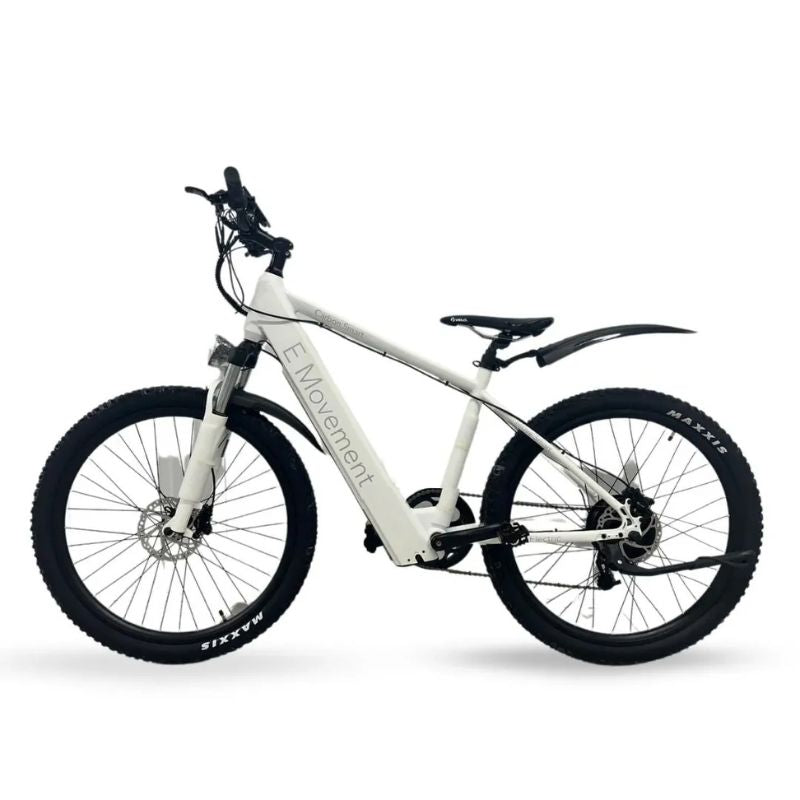
Best for: the rider who wants a sportier, lighter bike for hills, trails, and the commute in between.
If fat tyres aren't your thing and you'd rather have something that feels like a proper mountain bike, the E-Movement Thor is the one I steer people towards. It's currently £1,199.99, down from £1,699.99, and it's the lightest bike in this guide at 22 kg – a real difference if you've got to lift it. You get a 250W Bafang motor, a 36V 10Ah Samsung battery, 27.5" Maxxis tyres, and a lockable hydraulic suspension fork, all on a 6061 aluminium hardtail frame with SRAM 7-speed gears and hydraulic disc brakes.
It's genuinely capable on the climbs and on light off-road, which makes it a natural pick for towpath-to-trail weekends and the school run during the week. Two honest caveats. First, the payload is 120 kg rather than 150 kg, so very heavy riders or heavy loads point you elsewhere. Second, the Thor is offered in 250W and 350W versions, and only the 250W is road-legal under EAPC rules – the 350W is for private land only. Buy the 250W unless you've genuinely got land to ride on. Minimum rider height is 5'5", and it suits tall riders well.
You don't have to take my word for it, either. Paul left us a 5-star review on Trustpilot after buying his: "Would just like to thank Joe and the team at E-Bikes Express for all their help with my Thor E-Movement purchase. I spent a week looking for a company with a good reputation, and I'm so glad I chose this company ... As for the bike, I'm really happy with it. The bike came built and ready to ride, keep up the great work guys."
3. Engwe E26 – the one for taller riders

Best for: taller riders, up to 6'5", who want comfort, range, and the choice of a crossbar frame.
The Engwe E26 is £1,299 and, crucially, comes in a high-step (crossbar) frame as well as a step-through. The spec sheet quotes a rider height of 5'6" to 6'5", which is unusually accommodating – most bikes give up around 6'2" – and a 150 kg payload. For a big rider, that's the difference between fitting the bike and fighting it.
The rest backs it up. Those 26" × 4.0" fat tyres plus a dual-suspension setup make broken tarmac and gravel edges feel manageable, the 48V 16Ah removable battery is rated up to 140 km in the lowest assist mode, and the 180 mm hydraulic disc brakes haul it up confidently on a wet morning. It comes with a rear rack and integrated lights, so it's ready to carry a bag and ride after dark out of the box. It's not light at 34.5 kg and it doesn't fold, so it wants a shed or garage. But for a tall rider who wants one comfortable, planted bike for commuting and weekends, it's hard to beat at the price – and the aggregated owner reviews sit at 4.7, which tallies with what we hear back.
4. Fiido Titan – the hauler for the heaviest riders and loads
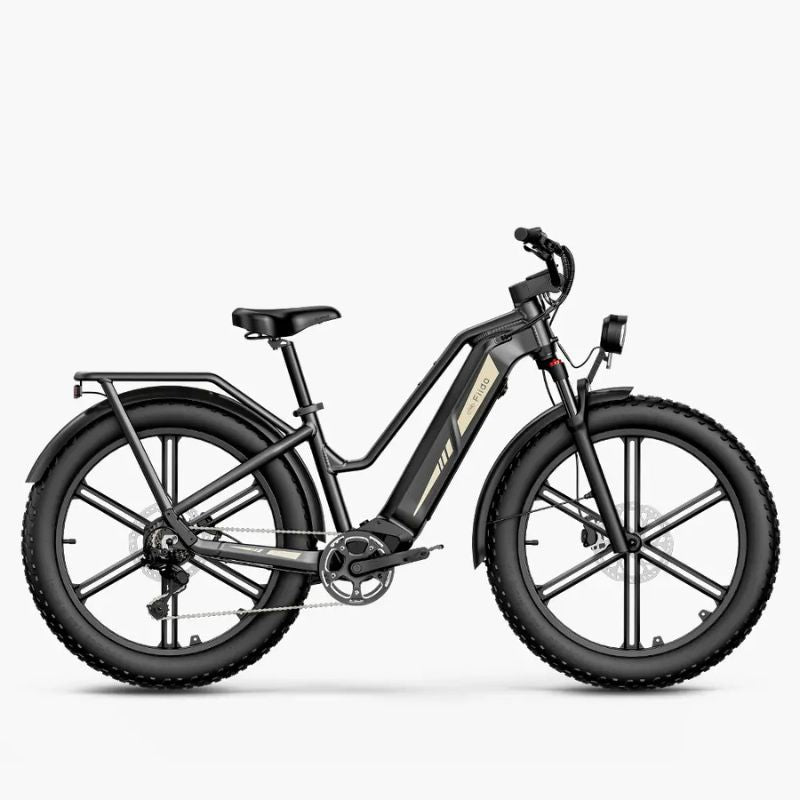
Best for: the heaviest riders, anyone carrying serious loads, and riders who want long range.
If payload is your deciding factor, the Fiido Titan stands alone here. It's rated to a 200 kg payload – split as up to 120 kg on the saddle and 80 kg on the rear rack – which is genuinely rare and exactly what a very heavy rider, or someone hauling tools and gear, should be looking for. It's built around a 26-inch aluminium frame on CST 26 × 4.0 fat tyres, with a torque-sensor 250W motor, a large 696 Wh battery for long range, and four-piston hydraulic disc brakes that match the bike's load-carrying brief.
It's pitched as a touring and cargo bike, so it's long, stable, and built for distance rather than nipping about – think running tools or kit out across an estate, or a long mixed-terrain weekend fully loaded. At £1,545 it sits towards the top of this list, and the trade-off for all that capability is weight and length. One honest note: stock comes and goes on the Titan, so it's worth checking current availability with us before you set your heart on it, or asking us to flag you when the next batch lands.
5. Engwe Engine Pro 3.0 Boost – the do-everything flagship

Best for: the rider who wants one bike to handle the roughest UK surfaces and still fold away.
The Engwe Engine Pro 3.0 Boost is the flagship at £1,699, and it's the most capable all-rounder of the group. It pairs full suspension – 50 mm up front, 62 mm at the rear – with 20" × 4.0" fat tyres, so it smooths out surfaces that would have the others working hard. The 48V 250W motor puts out 90 Nm of torque through a torque sensor, the highest figure here, which is what you want if your regular ride finishes uphill with a load. Range runs up to around 130 km in the lowest assist mode, the payload is 150 kg, and it folds for storage despite weighing 34.7 kg.
It's the one I'd steer you towards if your daily run is genuinely hilly and you ride it loaded – the 90 Nm of torque and the full suspension are exactly what make the difference there. The honest trade-offs: it's the priciest and heaviest folder here, the 20" wheels feel a touch less planted at speed than the E26's 26" hoops, and like the EP-2 the recommended rider height tops out at 6'2", so the very tallest riders are better served by the E26. But if you want maximum capability in one folding package, this is it.
Here's How They Compare at a Glance
| Model | Best For | Type | Range | Weight | Price | Shop |
|---|---|---|---|---|---|---|
| Engwe EP-2 3.0 Boost | Budget fat-tyre power | Folding fat-tyre | Up to 120 km | 32.3 kg | £1,099 | View |
| E-Movement Thor | Sporty road & trail | Hardtail mountain | Up to 55 km (est.) | 22 kg | £1,199.99 | View |
| Engwe E26 | Taller riders (to 6'5") | Fat-tyre crossbar | Up to 140 km | 33.5–34.5 kg | £1,299 | View |
| Fiido Titan | Heaviest riders & loads | Fat-tyre cargo | Up to 115 km | 37.8 kg | £1,545 | View |
| Engwe Engine Pro 3.0 Boost | Do-everything flagship | Folding full-suspension fat-tyre | Up to 130 km | 34.7 kg | £1,699 | View |
Which One Suits You?
Still weighing it up? Here's the quickest way to land on one.
If you're tall – over 6'2" – and want comfort, the Engwe E26 in the high-step frame is the obvious starting point. It's the only bike here that officially fits up to 6'5".
If payload is your worry, go straight to the Fiido Titan at 200 kg, or the E26 and the Engwe folders at a solid 150 kg.
If your route is properly hilly and you ride loaded, the 90 Nm torque of the Engwe Engine Pro 3.0 Boost is the strongest puller in the group.
If you want sporty and light, and a bit of trail, the E-Movement Thor is your bike – just buy the road-legal 250W version.
If you're watching the budget but still want fat-tyre capability, the Engwe EP-2 3.0 Boost gives you the most for £1,099.
A Few Questions That Come Up a Lot
Is there really such a thing as a "men's" electric bike?
Not in any technical sense – a bike doesn't know who's riding it. What's real is that taller and heavier riders, who are more often men, need bigger frames, higher payload ratings, and stronger torque, and those needs get overlooked on a lot of generic lists. That's what this guide is built around, rather than the colour of the paint.
I'm 6'4" – will any of these actually fit me?
The Engwe E26 is the one to look at first, as it's rated to 6'5" and comes in a high-step frame with more reach. The E-Movement Thor suits tall riders well too. The folding Engwes are comfortable up to about 6'2", so if you're taller than that, size into the E26.
I'm a heavier rider. What payload should I look for?
Honestly, treat 150 kg as your minimum – that's the all-in figure for you plus clothes plus any bag. If you're nearer or over nineteen stone, or you carry tools and gear, the Fiido Titan's 200 kg rating gives you proper headroom and a frame that won't feel like it's working too hard.
Are these powerful enough for steep hills?
Yes, within UK law. Every road-legal e-bike is capped at 250W, so the thing to compare is torque and the sensor. A torque sensor with a figure like the Engine Pro's 90 Nm will pull a loaded, heavier rider up a stiff climb far more convincingly than a basic cadence-sensor bike with the same wattage. Tip: on a hilly route, prioritise torque over headline range.
Why are the fat-tyre bikes so heavy, and does it matter?
The fat tyres, bigger batteries, and sturdier frames that make these bikes comfortable and capable also make them 32 to 35 kg. If your bike lives in a garage or shed and you ride it from there, the weight is a non-issue. It only really bites if you've got to carry it up steps or lift it onto a rack – in which case the 22 kg Thor is worth a serious look.
Are they all legal to ride on the road?
The versions I'd sell you for road use are, yes – 250W, pedal-assist, cutting out at 15.5 mph, so no licence, tax, or insurance needed. The only catch is that a couple of models (the Thor and some fat bikes) also come in higher-powered versions that are for private land only. If you're unsure, our guide to UK e-bike laws lays it all out, or just ask us and we'll point you at the road-legal spec.
The Honest Bottom Line
Think back to that rider I mentioned at the start – the one who'd quietly given up on a bike that never fit. Nine times out of ten, the fix isn't a more powerful motor. It's a frame that actually fits, a payload rating that isn't wishful thinking, and enough torque for the hills you genuinely ride. Get those three right and the bike stops being the thing holding you back. For a tall rider that usually means the E26 in the high-step frame; for a heavier rider or a load-carrier, the payload headroom of the Titan; for a hilly, loaded commute, the torque of the Engine Pro.
That's what the right bike does for a bigger or taller rider – it stops the bike being the limiting factor and just gets on with the job. None of these is "the best" in the abstract. The best one is the one that fits your frame, carries your weight without complaint, and has the torque for your hills.
Fancy a browse? Have a look through our fat tyre range and crossbar e-bikes, or if you're not sure which suits your height, weight, and route, drop us a message on live chat or email and tell us a bit about your setup. We'll point you at the right one and we'll be straight with you about it. If you're still comparing styles, our fat tyre electric bike buyer's guide is worth a read too.